Let us say you finally get your dream trip to Edinburgh.
You have saved for months, booked a package that popped up on every travel site, and watched VisitScotland reels of the Royal Mile and Arthur’s Seat. You step out of Waverley Station, your suitcase rattling on the cobbles, turn a corner and see, sprayed in big black letters:
“Tourists go home. You are not welcome.”
You would probably feel a mix of things. Embarrassed. A bit ashamed. Maybe even a little scared. And, underneath all of that, confused.
Because you did exactly what you were told to do, airlines sold you cheap flights. Tour operators bundled the city into weekend deals. Tourism boards told you to visit, loudly and often. How did you become the villain for turning up?
That is the deeper problem behind the “tourists go home” graffiti appearing in Barcelona and other cities. It looks like a simple story of rude, careless visitors and angry locals. In reality, it is about systems, policies and money.
And if we are going to talk seriously about overtourism, we need to stop pretending that individual visitors are the main characters.
The numbers: tourism is not a side hobby, it is the economy
First, a bit of scale.
In 2024, Spain received about 94 million international visitors, the highest number on record. Tourist spending reached around 126 billion euros and made up about 12.3 percent of the country’s GDP.
Broader estimates that include indirect effects put tourism’s contribution to the Spanish economy even higher, at roughly 248.7 billion euros in 2024, supporting about 3 million jobs, or nearly 14 percent of all employment.
Zoom in on Barcelona. The city of about 1.7 million residents welcomed around 26 million visitors in 2024. Housing protests there are not just about noisy stag weekends. Rents have soared, and many locals feel pushed out of their own neighbourhoods. In response, Barcelona has announced that it will cancel the licences of roughly 10,000 tourist apartments by 2028, a plan that Spain’s Constitutional Court has now backed.
Now look at Edinburgh, the city that could so easily be the next “tourists go home” headline.
In 2024, Edinburgh and the Lothians saw about 5.41 million overnight trips, with visitors spending roughly £2.66 billion. Other estimates suggest the wider visitor economy brings in around £2.7 billion a year and supports about 30,000 jobs in the city.
Tourism is not pocket money. It pays rent and wages. It keeps restaurants open in winter. It funds festivals that locals also enjoy. Edinburgh knows this, which is why the city is preparing to introduce a visitor levy of 5 percent on overnight stays, expected to raise up to £50 million a year to help pay for housing, parks and public services affected by mass tourism.
So when we say “tourists go home”, we are not just telling a few annoying visitors to push their wheelie cases elsewhere. We are also telling a big chunk of the local economy to disappear.
The fragile ecosystem visitors cannot see
Now flip back to that moment as a visitor.
From your point of view, you bought a holiday. You saw an advert, a guidebook, a TikTok. You compared prices on OTAs and other websites that exist purely to make travel easier. You assumed that if flights are sold, hotels are available, and DMOs are actively inviting you, then it must be fine to go.
What you do not see is the fragile ecosystem that sits behind your weekend break. A lot of the socio-political issues might not be so visible from the seat of a premiere sightseeing bus service.
You do not see the cleaner who travels in from the edge of the city because they can no longer afford a central flat.
You do not see the family who had their tenancy ended so their landlord could earn more from a short-term let.
You do not see local services stretched by piles of rubbish on festival weekends or bus routes reshaped around visitor flows.
Visitors are temporary. Residents live with the long-term consequences.
The truth is that most tourists have no idea how close a city is to breaking point. Why would they? There is no red warning light on Skyscanner that flashes when a destination has hit its social carrying capacity. Instead, they see glossy campaigns, cheap flights and hotel deals, all quietly nudging them to “book now”.
Blaming them for not understanding the full system is like blaming someone for gaining weight without ever mentioning that almost every meal sold to them is oversized, packed with hidden calories and heavily marketed. Personal responsibility matters, but it sits inside an environment that has been designed in a particular way.
Who made it so easy to turn homes into holiday lets?
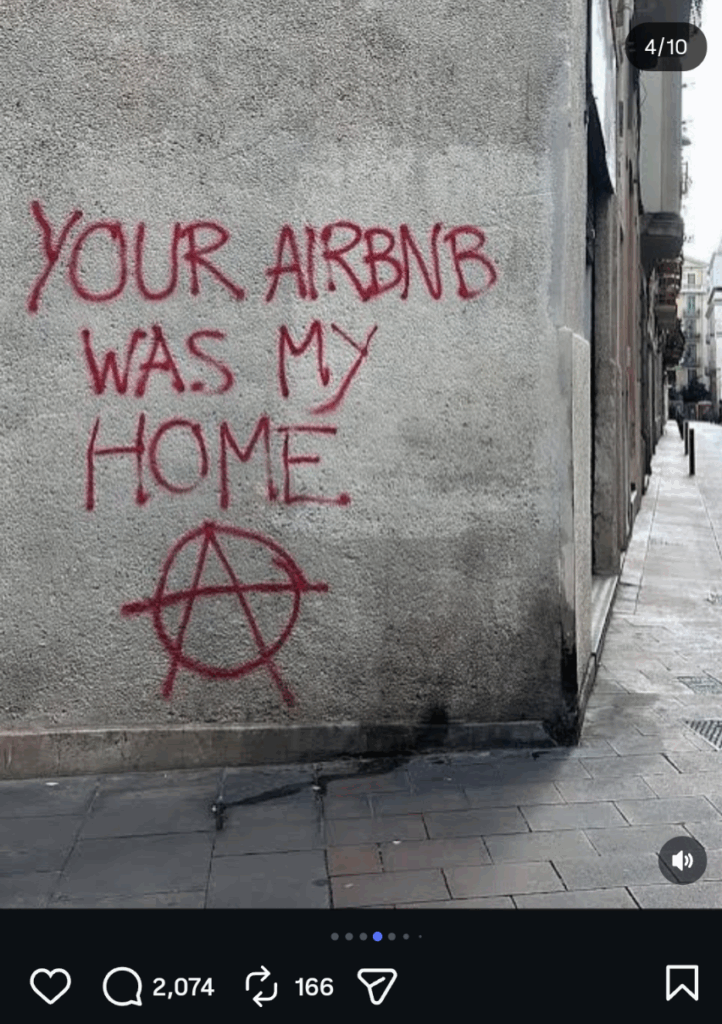
Take the Airbnb graffiti: “Your Airbnb was my home.”
On the wall, it reads as a personal accusation. In reality, it is a structural question.
Who allowed thousands of residential flats to be turned into holiday apartments?
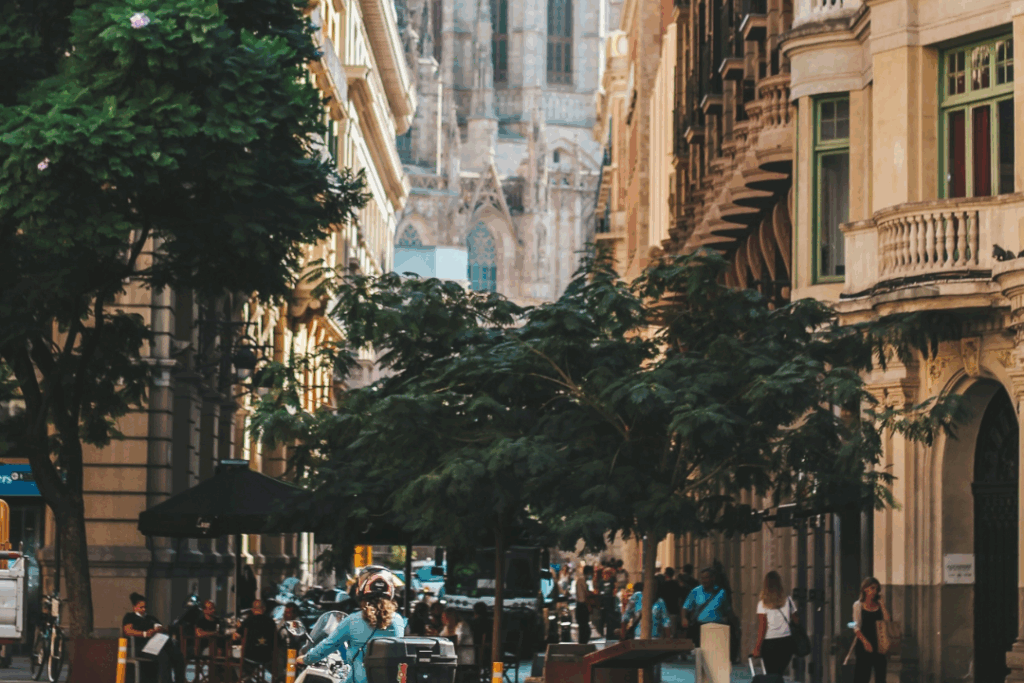
That did not happen because tourists begged for unregulated short-term rentals. It happened because:
- Local and national governments either relaxed rules or struggled to keep up with platforms that grew faster than regulation.
- Investors saw higher returns in short-term letting than in long-term tenancies.
- Platforms made it technically simple to list and book properties with a few taps.
Barcelona has not issued new tourist flat licenses since 2014, yet it still ended up with more than 10,000 legal holiday rentals and thousands more illegal ones. Freezing supply did not fix rents. Only now, with a complete ban on tourist apartments by 2028, are officials trying to unwind a decade of policy decisions.
Again, visitors booked what was placed in front of them. The structure came from elsewhere.
Why governments pushed tourism so hard
If overtourism is such a problem, why did governments and DMOs work so hard to attract visitors in the first place?
The answer is simple: growth.
After the 1992 Olympics, Barcelona deliberately branded itself as a global city-break destination, investing in marketing, cruise infrastructure, and urban regeneration. It worked, spectacularly. Only later did the full cost in housing, congestion and local frustration become clear.
Spain did the same at the national level. Tourism has become one of the country’s strongest economic pillars, accounting for more than 12 percent of GDP and around one in eight jobs. Now it runs some of the world’s best tourism and attractions in the world.
Scotland has followed a similar pattern, though at a smaller scale. Tourism is the lifeblood of many rural areas and a major employer nationwide. Edinburgh’s festivals alone attract global attention and pump money into the city every summer.
When you depend that heavily on visitor spend, you naturally chase more of it. Airlines are encouraged to add routes. DMOs are given targets based on volume. Cities build conference centres and cruise terminals. Each individual decision makes sense in isolation. Together, they push a place past the point where residents feel comfortable.
So again, when we see “tourists go home”, the honest response is not “yes, tourists are terrible”. It is “we built an economy that relies on them and then acted surprised when they came”.
Where visitors do have a part to play
None of this means visitors have no responsibility at all. We are all part of the system, even if we did not design it.
When you travel, you still choose:
- where you stay,
- when you go,
- how you behave in shared spaces,
- whether you spend money with local, long-term businesses or global brands that extract most of the profit.
You cannot single-handedly fix housing policy, but you can:
- book licensed, legal accommodation rather than bargain basement short lets that dodge local rules,
- travel outside peak weekends or months where possible,
- seek out local operators, guides and independent venues,
- learn basic “how not to be a nuisance” etiquette for the place you visit.
That is not a moral badge. It is just respect.
But visitor behaviour should come after, not instead of, the harder questions about regulation, taxation and planning.
Moving the conversation on from “tourists go home”
Angry slogans make for good Instagram slides, but they are a dead end if they are the whole conversation.
If you turned up in Edinburgh and saw a wall telling you to go home, you would feel hurt and defensive. You might even go online and argue that you have a right to be there. The debate would become one more shouting match between individuals.

What we actually need to ask is:
- How many visitors can this city realistically handle at once, without hollowing out its housing and services?
- How do we tax tourism fairly and reinvest that money where locals feel the benefit?
- How do we regulate short-term lets so that homes stay homes first, and holiday rentals second?
- How do we spread demand beyond one or two hotspots, both within a city and across a whole country?
- How do we change our metrics so “success” isn’t just measured by more arrivals, but by a better balance?
Those are questions for governments, city councils, DMOs, airlines, platforms and, yes, for us as travellers.
The next time you see a photo of “tourists go home” graffiti, try the Edinburgh thought experiment.
If that sentence was staring back at you from a stone wall by the Royal Mile, would you still think the visitor is the main problem? Or would you start to wonder about the decades of decisions that encouraged you to be there in the first place?
That is the article we need to write now. Not about evil tourists, but about the system that invited them and then pretended it had nothing to do with the invitation.
Need a leg up in the best practices of targeting travellers? Contact us today