In travel tech, there are a lot of products that sound like they do roughly the same thing.
A channel manager and a booking system are a good example.
Both deal with bookings. Both can connect to OTAs. Both can talk about availability. Both will probably appear in the same software comparison at some point.
But they are not interchangeable.
The easiest way to think about it is this:
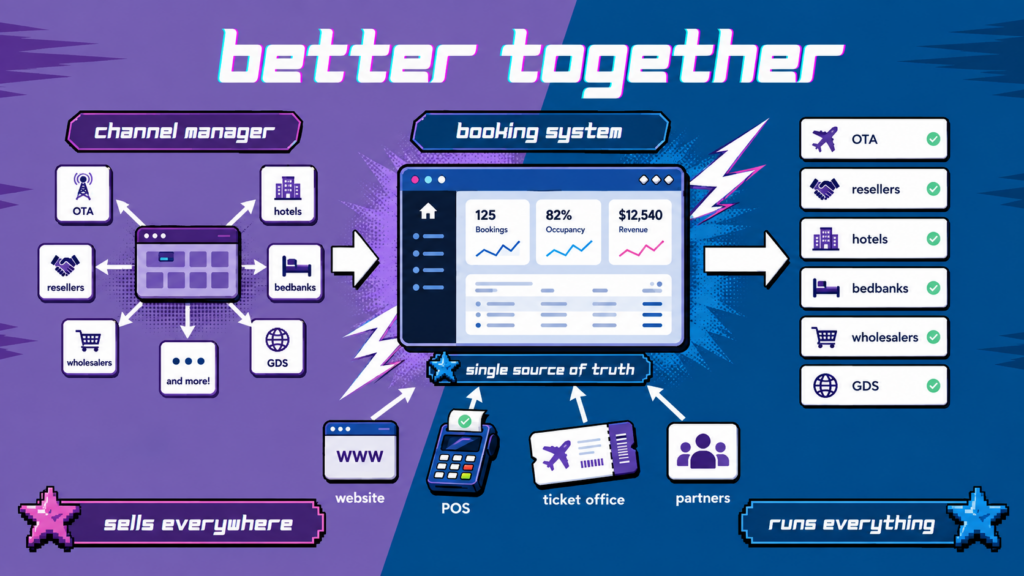
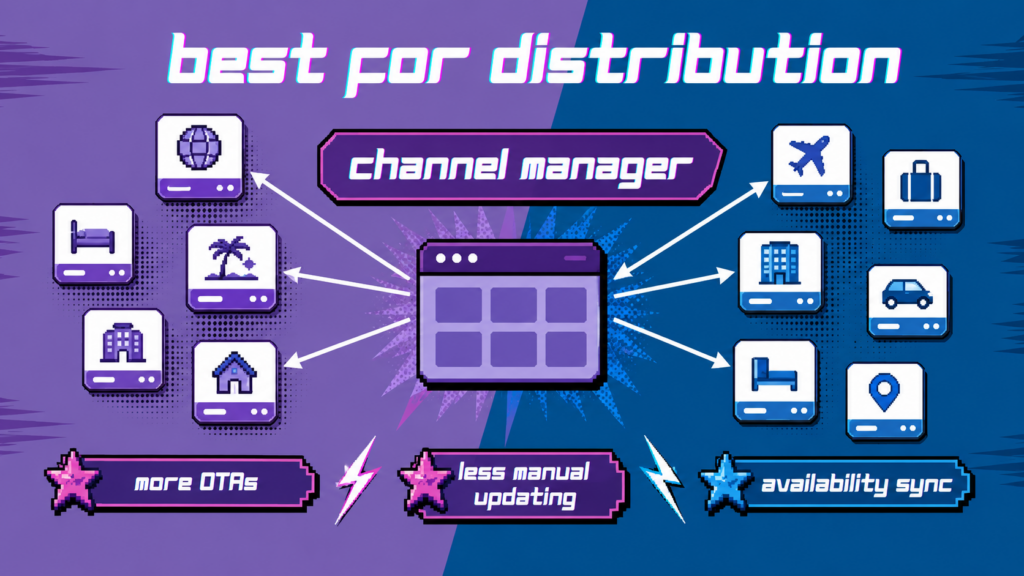
A channel manager helps you distribute your products to other places.
A booking system helps you actually run the business behind those bookings.
One is mainly about getting your products out into the world.
The other is about making sure that once those bookings start coming in, nobody has to keep the whole operation together with a spreadsheet, three WhatsApp chats, and a suspicious amount of optimism.
If either of those terms is still a little fuzzy, start with What is a channel manager? and What is a reservation system?. Then come back here and we’ll compare them properly.
So, what does a channel manager actually do?
A channel manager connects your products to third-party sales channels.
That could include OTAs such as GetYourGuide, Viator, Expedia, or other marketplaces and reseller platforms.
Its job is usually to help keep things like:
- Products
- Prices
- Availability
- Bookings
- Cancellations
moving between your system and those external channels.
So, instead of logging into several OTA extranets every morning and manually changing availability, a channel manager helps manage those connections from one place.
For operators selling through several OTAs, that can save a huge amount of admin.
It can also help reduce one of the least enjoyable surprises in tourism: selling the last seat twice.
If you want to go deeper into the distribution side, we have guides on why channel management is important and how tours and attractions use a channel management system.
And what does a booking system do?
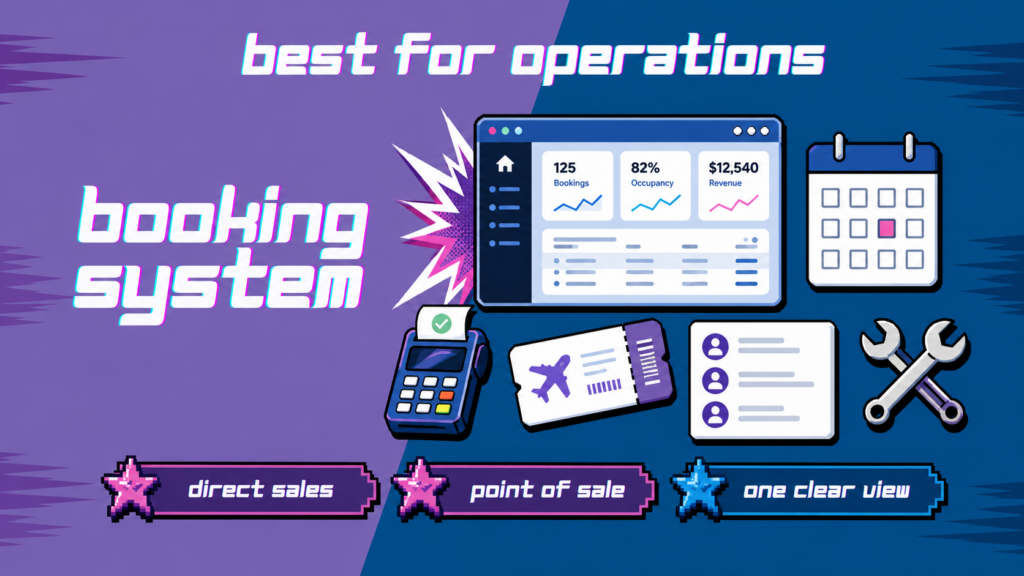
A booking or reservation system goes much further into the day-to-day running of the operation.
It can manage things like:
- Direct website bookings
- On-site sales
- Point of sale
- Products and schedules
- Capacity and availability
- Customer details
- Payments
- Cancellations and amendments
- Manifests
- Reporting
- Reseller or partner bookings
- Ticket validation
- Resources such as vehicles, guides, or drivers
In other words, it is where the booking becomes operational.
A customer might book a 10am boat trip through your website. Another buys at the ticket desk. A third books through an OTA.
Your booking system is the place where all three ideally end up looking like what they really are:
three people who need to get onto the same boat at 10am.
For a fuller introduction to what sits inside the reservation side of the business, read What is a reservation system? or Why tour operators should use a reservation system.
A simple example
Imagine you run a busy city sightseeing company.
You sell:
- Directly through your website
- From ticket offices around the city
- Through hotel partners
- Through GetYourGuide and Viator
A channel manager can help connect your product and availability to the OTAs.
But your operation still needs to know:
- How many tickets have actually been sold?
- Which departures are filling up?
- Did someone buy at the ticket office five minutes ago?
- Can a hotel partner still sell this departure?
- Has a cancellation freed up capacity?
- What does the driver or boarding team need to see?
That is where the booking system comes in.
The channel manager gets the distribution working.
The booking system helps the actual Tuesday afternoon work.
If you’re trying to understand where the customer-facing booking part sits in all of this too, Booking engine vs reservation system: what’s the difference? is a useful next read.
Why do operators confuse them?
Mostly because the boundaries have become blurry.
Some booking systems include channel management.
Some channel managers offer extra booking tools.
Some businesses use separate systems for each.
And some operators have accumulated technology over the years in much the same way people accumulate charging cables. Nobody is entirely sure where everything came from, but removing one feels dangerous.
The important thing is not the label on the software.
It is understanding what problem you are trying to solve.
You may mainly need a channel manager if…
Your biggest problem is distribution.
For example:
- You want to sell through more OTAs
- Your team is manually updating several channels
- Availability is inconsistent between marketplaces
- You spend too much time managing OTA extranets
- You already have a booking system you are happy with
- You want to expand distribution without replacing the rest of your setup
In that case, changing your entire booking system might be a rather dramatic response to a connectivity problem.
If this sounds familiar, our ultimate guide to channel management for tours and activities goes into the wider distribution picture in more detail.
You may need a stronger booking system if…
The problems are happening much closer to home.
For example:
- Direct, OTA and on-site bookings are difficult to see together
- Staff cannot trust the availability
- You rely heavily on spreadsheets
- Changes and cancellations create too much manual work
- Reporting is difficult
- Your point of sale and online sales feel disconnected
- Capacity is becoming harder to manage
- The operation has become more complicated than the software supporting it
At that point, adding another distribution connection may just mean sending more bookings into a system that is already struggling.
Which is technically growth. Just not the relaxing kind.
What about real-time availability?
This is where the two systems really need to work together.
If you sell the same experience through your website, ticket desk, OTAs and local partners, everyone needs an accurate view of what is actually left to sell.
Capacity is what you can deliver. Availability is what you still have left to sell.
If a ticket office sells the final two spaces, your OTA should not still think there are four available.
Likewise, if someone cancels, you ideally want that availability back on sale without a member of staff having to remember to update five different places.
Channel manager or all-in-one booking system?
This is probably the more useful question for larger operators.
There is no universally right answer.
A dedicated channel manager can make a lot of sense if:
- You already have strong operational software
- Distribution is the missing piece
- You need specialist connectivity
- You work with a large number of channels
An all-in-one booking and ticketing system may make more sense if:
- You want direct, OTA and on-site sales in one place
- Point of sale is important
- You manage high booking volumes
- Capacity and departures need close control
- Staff need one operational view
- You want fewer separate systems to maintain
For medium and large operators, the question is often less about features and more about how many moving parts the business can comfortably manage.
One extra system may be perfectly sensible.
Seven systems connected by “Claire knows how it works” probably deserves another look.
If you want to see what an all-in-one approach looks like in practice, Palisis brings ticketing, reservations, ecommerce and distribution into one platform. You can explore the all-in-one ticketing and reservation system or the TourCMS distribution solution separately.
Problems checklist for operators
Not sure which part needs attention? Start here.
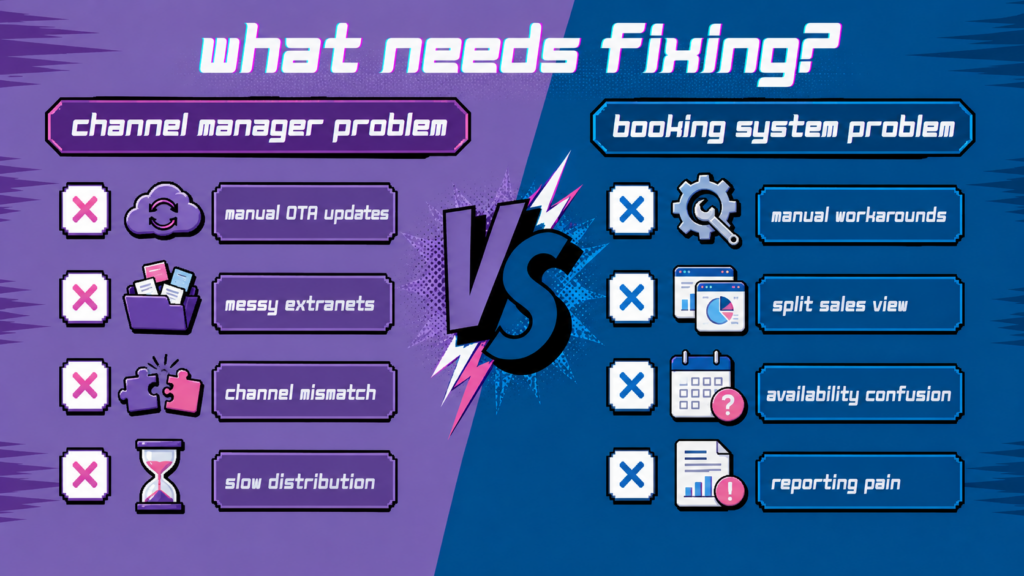
Your channel management may need attention if:
- OTA availability regularly differs from your own
- Staff spend hours updating products across channels
- New OTA connections take too much manual effort
- Cancellations do not reliably flow back
- Your distribution strategy is limited by the technology
In short: you can run the operation, but distributing it is harder than it should be.
Your booking system may need attention if:
- Your team cannot see all bookings in one place
- On-site and online sales do not share live availability
- Reporting involves too many exports
- Staff use manual workarounds every day
- Capacity is becoming difficult to control
- Growing sales are creating growing admin
In short: you are getting bookings, but managing them is taking too much work.
You may need to review both if:
- OTA bookings are growing, but errors are increasing too
- Different teams trust different systems
- Nobody is completely sure which platform is the source of truth
- Direct, partner, OTA and point-of-sale bookings are managed separately
- Your technology setup has grown one workaround at a time
That last one is very normal.
It is also usually the point where “but it technically works” stops being a particularly convincing argument.
What should growing tour operators look for?
If you are comparing systems, ignore the labels for a moment and ask what you actually need the technology to do.
Can it:
- Manage direct bookings?
- Connect to the OTAs that matter to you?
- Keep availability accurate in real time?
- Handle on-site or point-of-sale bookings?
- Manage cancellations and amendments?
- Support partner and reseller sales?
- Give operations one clear view of what has been sold?
- Handle the booking volume you have now, and the volume you are aiming for?
Those questions tell you far more than whether the product calls itself a channel manager, reservation system, booking platform, distribution platform, or any other combination of travel-tech words.
And if partner sales are an important part of your mix, What is a B2B reseller for tours and activities? is worth reading too.
The bottom line
A channel manager helps distribute your products and bookings across third-party sales channels.
A booking system helps manage the wider booking operation, including direct sales, availability, payments, capacity, point of sale and day-to-day operations.
For some operators, a dedicated channel manager alongside an existing system is exactly the right setup.
For others, especially those managing high booking volumes across direct, OTA and on-site sales, bringing more of that activity into one system can make life much easier.
The important thing is not choosing the product with the longest feature list.
It is knowing which problem you are actually trying to fix.
At Palisis, we work with tour and attraction operators that need direct sales, on-site ticketing, distribution and day-to-day operations to work together. If your current setup is starting to feel more complicated than the business it is supposed to support, it may be worth looking at whether you need another connection, or a more joined-up system in the first place.