In travel tech, some terms get used so often that they start to blur together.
Booking engine and reservation system are a good example.
People use them interchangeably all the time. Sometimes that is harmless. Sometimes it leads operators to buy something that solves one problem while leaving the real one untouched.
Although the two are connected, they are not the same.
And if your business is trying to improve online sales, reduce admin, or grow across more channels, understanding that difference matters more than it sounds.
That matters even more now that online booking is no longer a “nice to have.” It is simply how people expect to buy. In the UK, online travel penetration reached 88% in 2024 and is projected to rise further, while EU bookings through major online accommodation platforms reached 398.1 million guest nights in Q3 2025, up 8.7% year-on-year. Those figures are not tour-specific, but the direction of travel is clear: customers are comfortable booking online and doing so at scale.
At the same time, the booking experience still has a huge effect on whether a sale actually happens. Baymard’s checkout research puts average cart abandonment at 70.19%, and found that 18% of shoppers have abandoned a purchase because the checkout felt too long or too complicated. Again, that is broader ecommerce rather than tours alone, but the lesson still applies neatly to travel: if booking feels harder than it should, people leave.
They are part of the same journey, but they do different jobs
The easiest way to think about it is this:
- A booking engine helps customers make bookings.
- A reservation system helps the operator manage what happens after that booking is made.
One is an exclusive customer-facing entity, aimed at getting them to make bookings and to help convert interest into revenue. Whereas the other is operational, working for the operator, to make sure the business can actually deliver what has been sold.

That distinction matters because operators often start looking for “a better booking system” when what they really mean is one of three things:
- The online booking flow feels clunky
- The operational side is messy
- Both are creating friction
Those are very different problems, and they are not always solved by the same thing.
A simple example
Imagine a sightseeing cruise operator.
A customer visits the website, books two tickets for Saturday at 2pm, pays, and receives their confirmation in seconds. From the customer’s point of view, that feels like one simple action.
Behind the scenes, though, two different jobs need to happen.
- The booking engine shows the departure, price, ticket types, and checkout.
- The reservation system records the booking, updates availability, reflects it in reports, and makes sure the ops team can actually see those two passengers on the correct departure.
A weak booking engine is disruptive, messes with the flow of the sale, and leads to the ever looming abandoned cart.
However, if the reservation system is weak, the sale comes in, but the business ends up dealing with manual fixes, uncertainty, or that familiar moment where someone asks, “Wait, do we actually still have space on that one?”
Both of these situations present unique problems, which can both lead to you losing the customer, and damaging your reputation.
Why do people confuse them?
They usually work together so closely that they feel like one thing. And that’s because they both exist within the same funnel.
A customer will book through the booking engine, which then flows into the reservation system, which will handle all of the behind the scenes processes. Availability, staff visibility, and then the eventual tour and activity will proceed.
So operators often say things like:
- “We need a better booking system”
- “We need online reservations”
- “We need something better for bookings”
And what they actually mean may be one of the following:
- Our checkout is clunky
- Our team cannot trust the availability
- Reporting is messy
- OTA and reseller bookings are awkward to manage
- We have too many manual workarounds
- We need all of the above fixed before someone opens another spreadsheet
Fixing an issue with booking is completely different to reservation tech, and vice versa. So knowing which pain point corresponds with what tech is crucial to improving and scaling your business.
So what is the issue?
What a booking engine is not
A booking engine is not your whole website; It’s the part that turns that interest into a transaction.
That distinction matters because some operators assume that refreshing the website will naturally improve bookings. Sometimes they do. But if the booking flow still feels fiddly, disconnected, or awkward on mobile, the prettier homepage may not save it.
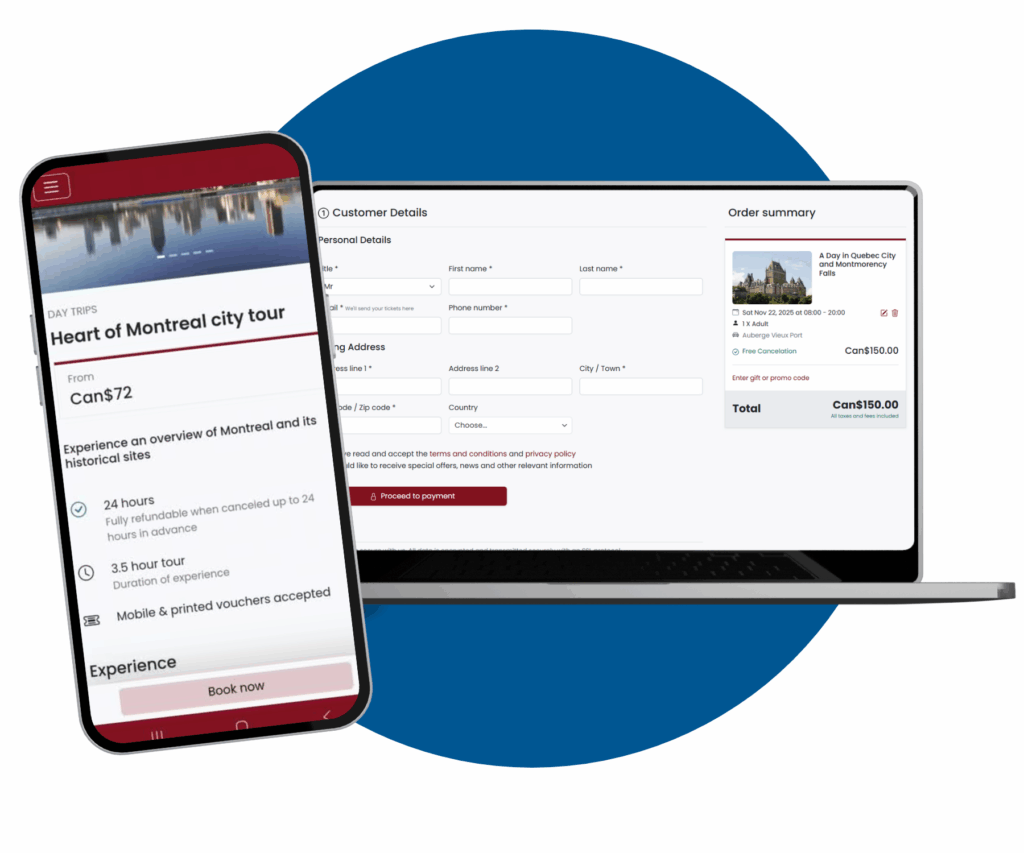
It is the difference between a lovely shop window and a till that only works if you press it in exactly the right place.
What a reservation system is not
A reservation system is not just a list of bookings. It is also not just a calendar with names in it.
For medium and larger operators, especially, it needs to manage real operational complexity. That can include:
Once you start selling across multiple channels and devices, the reservation system becomes less of an admin tool and more of a control centre.
At that point, “Can it store bookings?” is no longer the right question. The better question is, “Can it help us stay in control as we grow?”
Which one should operators care about more?
Both, but not always for the same reason.
If your biggest issue is conversion, the booking engine deserves attention.
If your biggest issue is operations, the reservation system probably does.
It’s important to keep your site health in your mind. Your business may have grown over time, a website tweak here, a workaround there. Integrating with new OTAs, new reseller processes, a few less-than-temporary spreadsheet solutions.
Chances are you need to check on both.
For smaller operators, a basic all-in-one tool may be enough for a while.
For medium- and large-sized operators, cracks usually show up faster. That is when the difference between “customers can technically book” and “the business can scale properly” becomes very obvious.
What operators should ask when choosing travel tech
If you are reviewing your setup, one of the most useful questions is this:
Are we trying to improve how customers book, how our team manages bookings, or both?
That sounds obvious, but it saves a lot of wasted time.
Sometimes operators buy a sleek front-end tool and then realise the back-office side is still messy.
They buy something operationally powerful, only to find that the customer journey still feels heavier than it should.
The strongest setup usually gives you both: a clear, easy booking engine for customers and a reliable reservation system for your team.
Because a nice checkout is great.
But if your operations team still has to untangle bookings manually at 8:07 on a Monday morning, the victory is incomplete.
👉 Contact us now to learn about our booking and reservation system