And that’s fine when you’re small, the day is simple, and the same two people can fix everything by shouting across the office. It stops being fine the minute you get busy.
Because the day-to-day reality of tours and attractions is not “Departure at 10:00”. It’s a chain reaction:
- A school group shows up 15 minutes early
- A family wants to switch to the next slot because their lunch ran late
- A reseller calls with a last-minute booking
- A guide is stuck in traffic on the way back from the previous tour
- Someone decides to pay on site, and you need to keep the queue moving
There are simply too many factors at play to easily account for it all, and this is where most operations struggle. Not because the staff aren’t good, but because the tools don’t show the day properly.
The problem with start times
Start times are useful, but they can also be misleading. There is more to planning than just knowing where to be for a certain time, especially when you have a day full of departures ahead. It doesn’t matter if you have an best ticketing system, when you are bottlenecked by your backend.
If all you can see is when something begins, you still don’t know if your day actually works.

Because what matters operationally is time blocks. A tour doesn’t take “10:00”, it takes 10:00 to 12:15 and requires a guide. It takes a vehicle. It takes capacity. It takes a meeting point handover. It takes turnaround time.
All of these factors play into a successful schedule. If you rely only on start times, you will find yourself relying on luck that everything will go according to plan.
But getting lucky is no plan at all. And no matter how amazing your sightseeing tour may be, people won’t recommend it if you were late because of poor planning.
Why end times change everything
Once you include end times, a few things suddenly become obvious:
- Two departures overlap, even if the start times look spaced out
- The same guide has been assigned to two tours that physically cannot both happen
- A vehicle has no turnaround time between trips
- A “quick” 45-minute tour is actually a 2-hour commitment once you include check-in and travel time
End times are the difference between “we’ll figure it out” and “this is doable”. Because it does more than just showing you when your next departure begins, it lets you know how capable you are of committing to your schedule with your existing resources and plan.
If you’ve ever had a day where the plan looked fine until reality arrived, this is usually why. And that stress can make or break your day.
“But we manage it in our heads”
Of course you do. Everyone does… until you can’t.
“I’ll do it on the night” isn’t part of the formula for success. Eyeballing it can work when the operation is small, but scaling means investing in your ability to oversee your day-to-day performance in a reliable way.

Most operators reach a point where they start building a second system on the side:
- A spreadsheet that someone updates religiously
- A WhatsApp thread that contains the truth
- A whiteboard that holds the real schedule
- A team member who becomes the human calendar
That works right up until that person is off sick, or you add another route, or you start selling through more partners, or the season gets busy and the exceptions multiply.
This is usually the moment operators say:
“We need a proper calendar.”
What they often mean is:
“We need something we can trust.”
When plans meet reality
Strong planning starts in the back end, where your team sets up departures, assigns resources, and defines availability. But even the best plans can fall apart on the day.
There are countless challenges that operators face, daily: walk-ups push your capacity, guests want to reschedule, agents call with last-minute bookings. And your team? They’re dealing with it all in real time.

If the system can’t show the day clearly, including who’s assigned where, what’s overbooked, and what’s running late, your staff end up improvising in front of guests.
And that’s when service slips. And slipping service can mean bad reviews.
Guests don’t know what tools you’re using. But they do know when a queue moves slowly, or your staff seem unsure.
That’s why a connected calendar, built around proper start and end times, ends up having a huge impact.
What a real ops calendar should do
A useful ops calendar is not just a view. It’s a decision tool.
At a minimum, it should help you:
- See the day in time blocks, not just a list
- Spot clashes quickly
- Understand what’s running now, what’s next, and what overlaps
- Support resource planning (guides, vehicles, equipment)
- Give the team confidence to handle changes on the day
When you have that, the day runs more smoothly, even when things go wrong.
Because things will go wrong. Travel is travel.
Where Palisis fits
This is exactly the gap we’re closing with our calendar and resource management improvements.
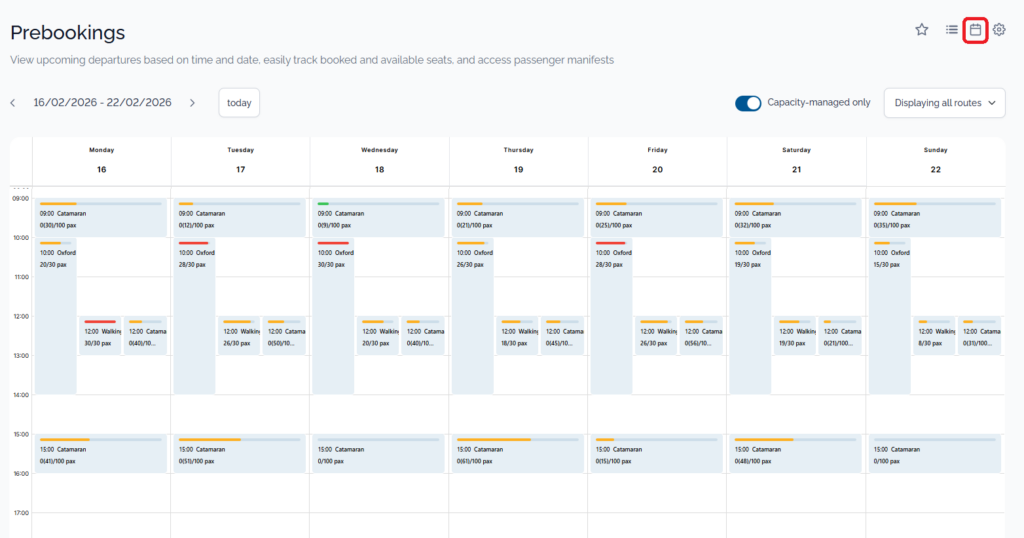
We’re moving away from “a list of departures” and towards a proper time-based calendar view that reflects how operations really run. That includes support for start and end times, better scheduling, and more control over what’s visible where.
The goal is simple: give operators tools that match how the day actually unfolds, so your team spends less time firefighting and more time delivering great experiences.
A quick gut check
If any of this sounds familiar, you’re not alone:
- You cannot confidently assign guides without checking three places
- You rely on a spreadsheet to understand the true schedule
- Overlaps only become obvious when it’s too late
- Your team has to “figure it out live”
That’s the sign your calendar isn’t a calendar yet.
And fixing it is one of the fastest ways to reduce stress across your whole operation.
If you are looking to get started with Palisis’ new Calendar view, check out our support article or contact our team for help!