Have you ever stood at a turnstile, ticket in hand, wondering whether to push, scan again or wait for someone to come and help? It’s a small moment, but it shapes how the whole visit starts. It’s also why the “turnstiles vs access gates” question rarely has a one-size-fits-all answer. The right choice depends as much on the space around your entrance, and the way people move through it, as on the device itself.
The short version
- A tripod turnstile suits steady, repetitive entry where you want one person through at a time.
- An access gate, such as a flap gate, suits entrances where visitors need more room, and wider versions work for wheelchair users and pushchairs.
- A self-service validator with no barrier may be enough if your building already controls where people can go.
- Many attractions combine them: turnstiles for the main flow, with a wider gate alongside.
Below, we explain how each option works, when each one makes sense and what to check before you choose. We also walk through two examples where the ticket rules are almost identical, but the right entrance isn’t.
What is the difference between a turnstile and an access gate?
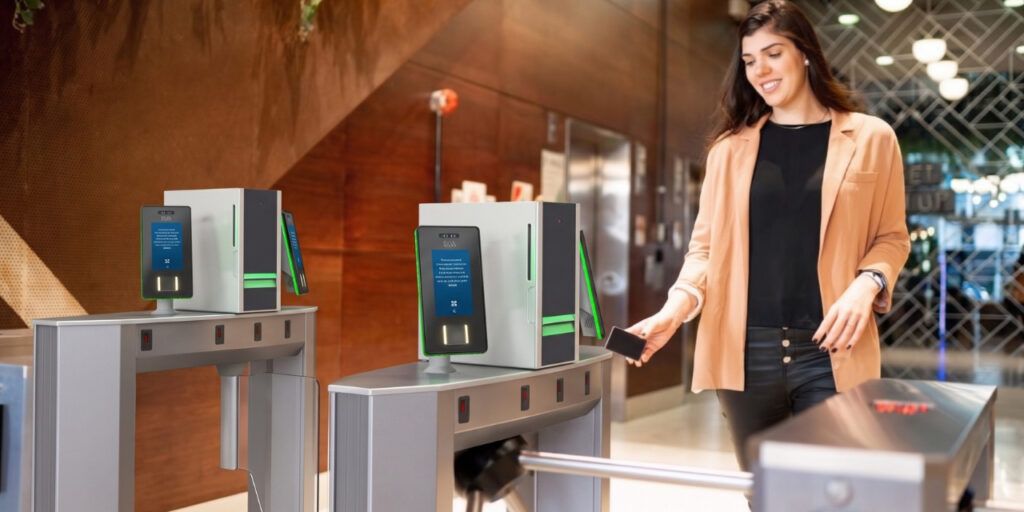
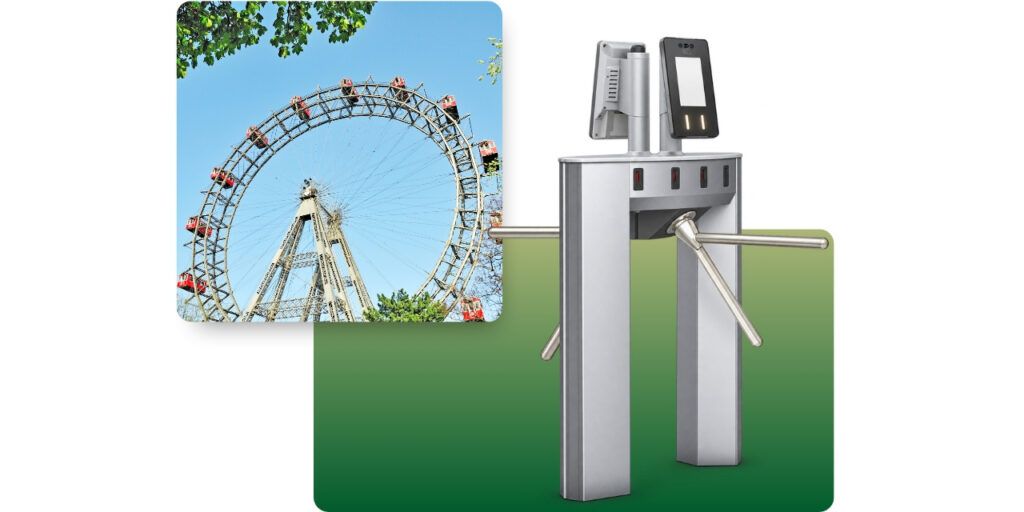
A tripod turnstile is the classic three-arm barrier. The visitor scans their ticket, the arm unlocks and they push through. One person, one rotation, next person.
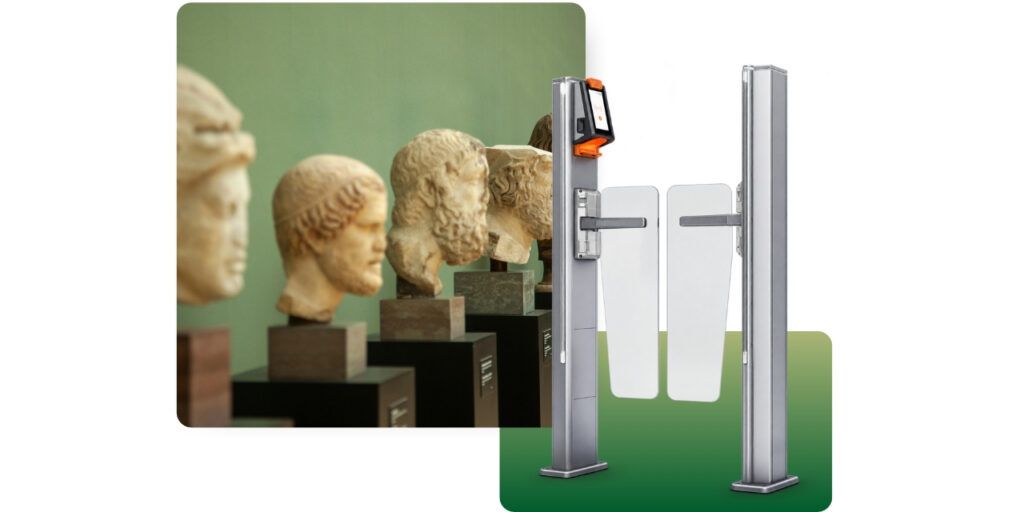
An access gate controls entry with a barrier that opens rather than rotates, such as the flaps on a flap gate. Gates can also come in wider configurations, which give more room to wheelchair users, families with pushchairs, people carrying bags or anyone who needs extra space.
Think of a supermarket checkout. Most of us are perfectly happy in the normal lane. Add a trolley, three bags and a toddler making a break for the exit, and the wide lane suddenly looks very sensible.
There’s also a third option worth knowing about: a self-service validator, which checks tickets without any physical barrier. Here’s how all three compare:
- Tripod turnstile: scan, then push through a rotating arm. Best for steady, one-at-a-time entry with a repeatable rhythm. Watch out: many wheelchair users can’t use one, so it shouldn’t be the only way in.
- Access gate (flap gate): scan, then the flaps open automatically. Best for entrances that need more room or an accessible passage (in a wider version). Watch out: it needs enough floor space for the gate width.
- Self-service validator: scan and walk on, with no physical barrier. Best for sites where the building layout already controls movement. Watch out: it relies on staff or the layout to stop people walking past.
When it comes to turnstiles vs access gates, neither option is better on its own. The real question is how people arrive, enter and leave.
Choosing a turnstile or access gate starts with how visitors move
Example 1: a small site in a historic building
Picture a small museum in a historic building. Space is tight, visitor numbers need careful management and there may be only one practical entrance.
Here, the main challenge is control. Every visitor needs a valid ticket, they need to enter at the right time and the entrance can’t become a bottleneck in an already narrow space. If wheelchair users, pushchairs and visitors who need more room all share that same path, a wider access gate is the sensible choice.
Example 2: a ride or timed attraction that runs in cycles
Now imagine a ride or a timed show. When one session ends, a large group leaves at roughly the same time, and the next group starts moving towards the entrance.
That’s a different problem altogether. This time it’s about rhythm. You might have a few quiet minutes, then a sudden wave of visitors who all need to get through quickly. A traditional turnstile handles this well because it sets up a simple, repeatable pattern: scan, enter, next.
The ticket rules could be almost the same in both cases. The physical entrance doesn’t need to be, and that’s why turnstiles vs access gates is really a question about your space, not just your hardware.
Plan entry and exit together
At some attractions, people drift out gradually and the exit barely affects the entrance. At others, a whole group finishes at once.
If people have to enter and leave through the same narrow point, even a very good turnstile can end up in a bad layout. Before you choose the hardware, ask yourself:
- Do you need separate entry and exit paths?
- Should one lane be wider than the others?
- How will groups move through together?
- What happens in the space immediately after the gate?
This matters most at busy times, and one of the best-documented examples comes from Florence.
The Uffizi Gallery can only hold a limited number of people at once. Once it was full, nobody could go in until someone came out, and visits have no time limit. So on free-entry Sundays, visitors without a booking simply joined a long queue outside and waited for space to free up.
In 2018, researchers from the University of L’Aquila tested a different approach on those Sundays. Instead of queuing, visitors went to digital kiosks outside the gallery, picked an available 15-minute entry slot and printed a voucher. They were then free to leave and come back at their chosen time, when the voucher was scanned at the door and they walked straight in. Behind the scenes, the system forecast how many people would arrive and how long they would stay, so it only released as many slots as the gallery could actually hold.

The difference was big. On the first Sunday in September 2018, under the old system, the average wait was 64 minutes. On the first Sunday in October, with the new system running, it dropped to 14 minutes, even though more people visited (7,765 compared with 6,961), according to the team’s published study.
Notice what changed: not the hardware at the door, but when people arrived at it. In fact, the researchers note that the historic building had limited space to fit proper turnstiles at all. Visitor flow depends on the whole entrance setup, not just the device you put in it.
Don’t treat accessibility as a side door
Standard tripod turnstiles aren’t usable by many wheelchair users, so an entrance that relies only on turnstiles can shut some visitors out. In the UK, the Equality Act 2010 requires service providers to make reasonable adjustments where a physical feature puts disabled people at a substantial disadvantage, and that explicitly includes features of the way into a building, as well as equipment. The Equality and Human Rights Commission’s code of practice for services adds that this duty is anticipatory: you’re expected to think about these barriers before a disabled visitor arrives, not once they’re already stuck at the entrance.
Requirements vary from country to country, so check the rules that apply to your site. As a practical starting point, if you use turnstiles, plan at least one wider gate on the same route, rather than sending some visitors round to a different entrance.
What happens when a ticket doesn’t scan?
Someone arrives too early. A ticket has already been used. A booking needs a member of staff to take a look. If the gate just says ‘invalid’, you haven’t solved the problem. You’ve simply moved the queue from the ticket desk to the entrance.
Do you need a turnstile or access gate at all?
Not always. If your main goal is to let visitors scan their own tickets, and the building already controls where people can go, a fixed self-service validator may be all you need.
If you do need physical access control, start with how visitors use the entrance, then choose between a standard turnstile, a wider access gate or a combination of both.
Bringing ticketing and access control together
Visitors buy tickets in lots of places: your website, the box office, a reseller or one of the supported OTAs. They might have a single ticket, a group booking or a ticket that’s valid more than once.
Whatever they bought, the entrance has to recognise it and apply the right rules the moment they arrive, if you want to keep people moving.
The Palisis Gatekeeper series connects ticket validation with physical entry. You can choose from:
- Gatekeeper Validate: fixed self-service ticket validation, with no barrier
- Gatekeeper Turn: validation combined with a traditional turnstile
- Gatekeeper Flow: validation with an automated flap gate, also available in a wider configuration for accessible entry
Gatekeeper can validate webshop and box office tickets, individual and group tickets, multi-use tickets and supported direct OTA vouchers, depending on your setup. To see it in action, read how L’Aquàrium de Barcelona connects ticket sales and entry with Palisis.
Turnstile or access gate? A quick checklist before you choose
Before you settle on turnstiles vs access gates, run through these questions:
- How many people arrive at once at your busiest time?
- Does the same path need to work for wheelchair users and pushchairs?
- Do visitors enter and leave through the same point?
- Which ticket types will be scanned at the entrance (single, group, multi-use, OTA)?
- What should happen when a ticket is rejected, and where will staff be?
- How much floor space do you have for the hardware?
Explore the Palisis product tour or contact our team to talk through what would work best for your attraction.