Someone booked for 30. On the day, 24 show up. A family reserves 10 spots and spends the next fortnight adding and removing people as if they were editing a wedding guest list. A travel agent holds 50 places for a group that is still mid-tour when the reservation is made.
This is not unusual. Research suggests that group bookings change at least once before arrival in most cases. The organiser is juggling other people’s schedules, waiting on approvals, chasing contributions, or simply trying to get 25 humans to commit to anything at the same time. It is like herding cats, except the cats have a school trip permission slip that three of them forgot to return.
The gap between “we want to book” and “here is the final number”
Individual bookings are clean. One person, one decision, one payment. Done.
Group bookings are a different animal. There is nearly always a gap between the initial enquiry and the confirmed final number. That gap exists because group organisers are rarely working alone. They are waiting on headcounts, sign-offs, contributions, and confirmations from others before they can commit.

If your booking process expects everything to be locked in from the start, that gap becomes your problem. You end up fielding change requests, processing partial refunds, manually adjusting records, or asking customers to cancel and start again. For something that happens all the time, that is a lot of unnecessary work.
What a reservation actually does
Think of a reservation like a table hold at a restaurant. The spot is yours, the kitchen knows you are coming, but nothing is fully locked in until you sit down. That breathing room is exactly what group organisers need.
A reservation lets operators hold availability while the final details are still being sorted. It separates the act of securing the space from the act of taking payment, which is often what group customers need most. A top booking and reservation partner can make this smooth.
In practice, that might look like holding places for a school group before the final headcount is confirmed, sending a payment link once the organiser has approval to spend, or taking payment on arrival based on who actually shows up. The booking exists, the capacity is protected, and nobody has to pretend the number is final before it actually is.
The school trip problem, explained in one scene
A teacher books 30 places for a class visit. Reasonable number. Whole class, a couple of helpers, sorted.
Then the day arrives. Two children are off sick. One parent helper pulls out. A second teacher decides to join. The group is now 28, maybe 29, possibly 31.
 27 2 2021 university or college students with face mask gather together to listen to professor or teacher about field hydraulic test in a borehole during field trip in Hong Kong
If the full amount was paid upfront, someone now has to work out the difference. If the system does not allow adjustments, your front desk team is sorting it out manually while a queue builds behind them. The teacher is stressed. Your staff are stressed. And the whole thing could have been avoided with a process built for how groups actually work.
Why payment links are more useful than they sound
A lot of group organisers are not the ones paying. They are the ones coordinating. The person who actually approves the spend might be a school business manager, a finance team, a company administrator, or a hotel partner.
Sending a payment link once the organiser is ready removes a surprising amount of friction. It sounds like a small thing. In practice, it is the difference between a booking that completes smoothly and one that stalls for three days while someone tries to find the right person to authorise it.
On-arrival payment is not cutting corners. It is cutting admin.
For operators working with schools or trusted trade partners, taking payment on arrival is often the most sensible option. The group shows up, you confirm who is there, and you charge for the actual number.
It is not the right model for every operator. High-demand time slots and limited capacity often need deposits or prepayment to protect revenue. But for the right relationships, it removes a layer of admin that did not need to be there in the first place.
Flexibility still needs a framework
Giving groups more flexibility does not mean giving up control. It means deciding upfront how your reservation process works, so everyone knows the rules.
That includes things like how long you will hold availability before releasing it, whether organisers can adjust numbers up or down, which trade partners can manage their own reservations, and what happens if a group does not show. Clear rules make the flexibility work for you, not against you.
This is what Palisis is building
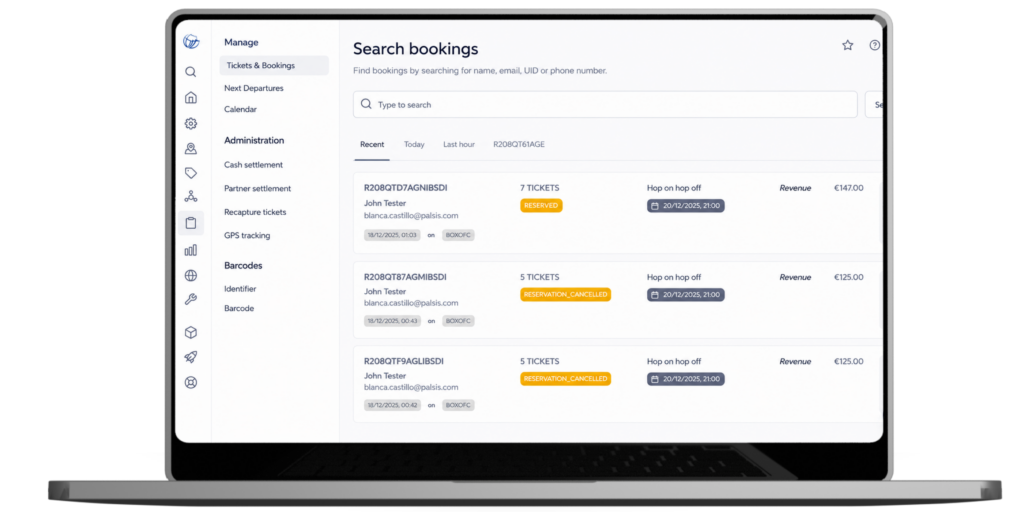
The new Palisis Box Office includes reservation functionality designed around how group bookings actually work in the real world. Operators can hold availability without immediate payment, send payment links, take payment on arrival, and adjust quantities without creating a paper trail of cancellations and rebookings.
It is built for the teacher with 30 pupils… who might be 27 by Thursday. For the travel agent with a group that is still on a coach somewhere. For the family organiser who just needs everyone to confirm before they can pay.
Group bookings are always going to be a bit messy. Your process does not have to be.
Get in touch with Palisis to find out more.