You know that feeling when a travel agent emails you with “can you just…” and you instantly know you’re about to lose 20 minutes of your life.
- “Can you move the booking by one hour?”
- “Can you add two people?”
- “Can you invoice us at the end of the month?”
- “Can you do it quickly? The guests are in the lobby.”
None of this is unreasonable. It’s just the wrong workflow.
A B2B portal exists because trade partners sell differently to normal customers, and your B2C checkout was never designed for that.
The why: trade is too valuable to run on favours and email threads
Experiences are getting bigger and more competitive. Arival put the tours, activities and attractions market at $271bn in 2025, projected to reach $342bn by 2029.
At the same time, distribution is getting more complex. OTAs are taking a bigger share of bookings. Arival data reported by PhocusWire shows OTAs accounted for 37% of experience bookings in 2025, up from 33% in 2024 and 28% in 2023.
So where does trade fit in?
Trade is often the “middle” of your sales mix, not a big API partner or a one-off customer. The people who book for groups, or for travellers who want someone else to sort it out.
If you make trade hard to work with, they will simply sell something else.
What operators try instead (and why its chaos sometimes)
If you do not have a B2B portal, most businesses end up with a patchwork of workarounds. Usually some mix of:
- Promo codes on the B2C site
Works until someone needs invoicing, a name change, or a booking tweak.
- “Just use the normal checkout”
Which is basically saying: “Please enter card details for every booking forever.”
- Manual booking by your team
The classic. Your staff become a human booking form.
- Cancel and rebook as a process
It technically works, but it’s a great way to create avoidable mistakes and unnecessary stress.
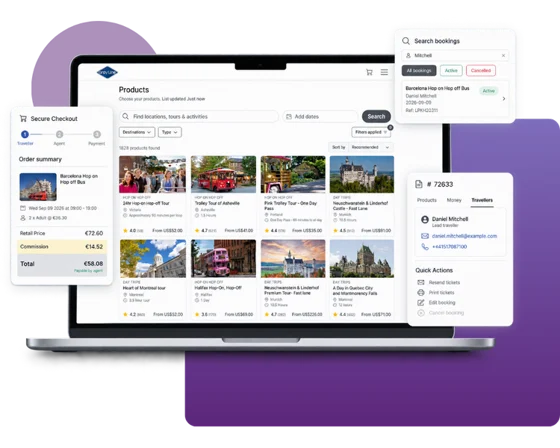
What a B2B portal actually is
A B2B portal is a self-serve booking space for your trade partners, built around how they operate.
Instead of pushing them through a B2C checkout, you give them a place where they can:
- Find availability quickly (often for groups)
- Book on behalf of a client
- Manage changes within the rules you set
- Pay in the way that matches the relationship
What does it change in real life
1) Payments stop being awkward
Trade partners are not all the same.
Some partners should pay by card every time. Some are trusted and prefer a monthly invoice. A B2B portal lets you set that up properly, instead of having the same “can we pay later?” conversation 200 times a year.
2) Your support team gets their time back
When trade partners cannot manage bookings themselves, they default to emailing support.
That creates a bottleneck, and the painful part is who gets stuck waiting. Your B2C guests, who usually need urgent help in the moment, get pushed behind admin work.
A portal shifts the routine workload back to the partner, with limits and guardrails in place.
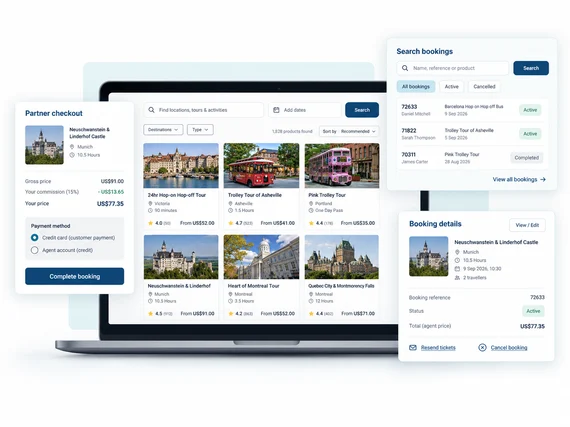
3) Edits happen faster, with fewer mistakes
Most trade changes are not complicated. They are just time-sensitive.
A portal lets partners handle common edits themselves (within your rules), rather than sending messages back and forth while the departure time creeps closer.
4) It makes the “in between” partners viable
There’s a whole category of partners who sit in the middle:
- Too big and frequent to be a smooth fit for B2C checkout
- Not big enough to justify a full API build and integration project
A B2B portal is for that exact group.
The benefit: you look easier to work with
Trade partners are busy. They sell what feels simple and reliable.
If your process makes them jump through hoops, they will sell the operator whose process does not.
A simple gut-check: do you need one?
If you recognise two or more of these, you’re probably ready:
- Partners ask for invoicing or credit terms
- Your team manually edits bookings for trade partners
- You get lots of “small change” emails that eat your day
- Group bookings are common, and availability searching is painful
- You rely on “cancel and rebook” to fix normal requests
👉 Contact us now to explore our B2B portal and see how it can streamline your business today.