What are fake reviews?
Fake reviews have become one of the biggest challenges in travel. Customers rely on reviews to decide what to book, but a growing share of what they read simply isn’t real. Some companies pay for glowing feedback, others use bots to inflate ratings, and even major platforms struggle to keep up. It has created a situation where honest operators feel drowned out.
And of course, we now live in an era where the moment anyone sees something suspicious online, the first reaction is a familiar cry of “fake news”. It might be a political catchphrase, but it captures a real problem: people no longer know what to trust.
That uncertainty hurts everyone. Travellers hesitate to book. Good operators lose visibility. The whole sector pays the price for a handful of bad actors.
This article explains why fake reviews matter, how they show up, and what operators can do to earn genuine feedback that lasts.
Why fake reviews matter
Reviews are the social proof that drives sales. For many travellers, they are more persuasive than a brand’s own marketing. But when those reviews can’t be trusted, everyone loses.
A 2023 study by Which? Found that up to 15% of TripAdvisor reviews showed signs of suspicious activity.
Globally, the World Economic Forum estimates that fake reviews influence more than $150 billion in online spending annually.
The real impact on operators
Lower conversion rates
When customers spot questionable reviews, they leave. That hesitation directly reduces your conversion rate and increases your cost per acquisition.
Unfair competition
Companies buying fake reviews gain an artificial edge. They climb rankings faster and push genuine businesses further down the list.
Eroded trust
When travellers feel tricked by misleading feedback, they don’t just distrust that operator; they distrust the entire platform or destination.
Higher ad costs
Fake listings and inflated rankings distort the market. Real operators end up paying more for clicks and keywords that now attract less confident customers.
Common types of fake reviews
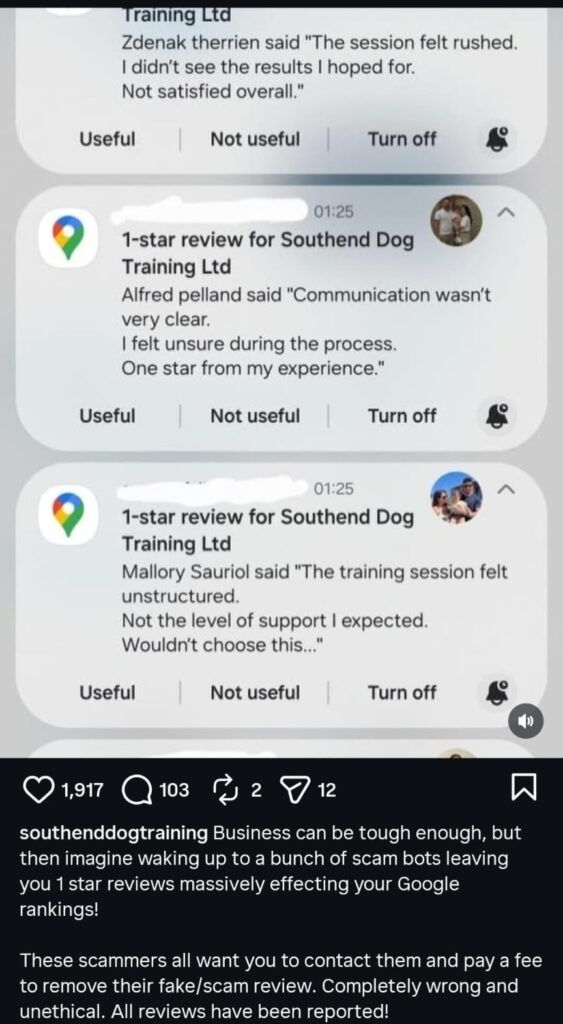 Image of Spam bots impacting a business
Paid reviews
Individuals or services are paid to post positive feedback, often using real-sounding profiles.
Bot-generated reviews
Automated accounts produce large volumes of similar comments to boost ratings overnight, or to tank your business and make you pay to have them removed.
Manipulated review requests
Some businesses only ask satisfied guests to review, while quietly ignoring others. It’s not illegal, but it’s misleading.
Competitor sabotage
Fake negative reviews targeting rivals are rarer, but they do happen.
Reseller manipulation
In a few cases, resellers or OTAs inflate reviews for their listings to improve rankings.
Why this matters for customers and the industry
When fake reviews dominate, travellers lose confidence and hesitate to book. A survey found that around four in five consumers had read a fake review in the past year, and 72% believe fake reviews are now “the norm”. Lower trust means fewer conversions, fewer repeat visitors, and a weaker online reputation across the sector. Once lost, that trust is hard to win back.
If you want to be a booming tour operator, you should never disregard customer trust.
How to spot suspicious reviews
- Reviews that sound vague and could apply to any tour
- A sudden burst of five-star ratings in a short time frame
- Reviewers with no photo, no review history, or an identical writing style
- Repetitive language or identical phrasing across multiple accounts
How to earn genuine reviews
Its important to remember what matters when looking for reviews. Providing excellent services and experiences are key to curating quality feedback that you can be proud of. Of course there are always going to be outliers and people who complain about minutia – but who’s to say you can’t turn that into cool content?
1. Ask every guest for feedback
Make it easy and automatic. A polite message within 24-hours of the tour increases response rates dramatically. Include a direct link to your preferred platform.
2. Keep it simple
Ask one question: “How was your experience?” Overcomplicating the request leads to fewer responses.
3. Personalise the message
Mention the guide’s name or the specific tour. It feels human and increases trust.
4. Respond to all reviews
Thank happy guests and resolve issues quickly for those who weren’t. Public responses show accountability and care.
5. Avoid incentivising reviews
Never pay for or reward positive reviews. If you do run promotions, make it clear that feedback can be positive or negative.
How to protect your reputation
Monitor regularly
Set aside time each week to check for new reviews. Platforms like Google and TripAdvisor now flag “suspicious activity” and use those alerts.
Report clearly
If you find fake reviews, report them with evidence such as screenshots or booking IDs. Persistence helps; removal processes can take time.
Be transparent
If a fake review remains online, respond calmly and professionally. Explain that you have no record of the booking and have reported it. Travellers will see your integrity.
Train your team
Your staff should know how to ask for reviews ethically and how to spot unusual activity. The earlier you catch issues, the easier it is to contain them.
Governments are starting to take this seriously.
- The UK’s Digital Markets, Competition and Consumer Bill will make the practice of creating fake reviews a banned activity under consumer law.
- The European Union already includes fake reviews under its Unfair Commercial Practices Directive.
- Platforms such as Amazon, Google, and TripAdvisor have all been fined or required to tighten verification systems.
This shift is good news for operators who play by the rules. It rewards transparency and discourages those trying to game the system.
Final thought
Fake reviews may seem like someone else’s problem, but they affect everyone. They drive up costs, damage credibility, and make customers hesitate.
The good news? Honest operators still have the upper hand. By asking for authentic feedback, responding openly, and building trust through transparency, you can stand out for all the right reasons.
If you’d like help improving your review process or integrating it into your existing system, we can guide you through it. The most powerful marketing is still the truth, told by the customers who genuinely loved what you created.
Looking for more marketing ideas?
This article was written by our VP of Marketing, Jessica, as part of our practical marketing advice for tour and activity operators.
From email campaigns and direct bookings to content, customer behaviour and the occasional “why are we still sending this?” moment, we share ideas based on the things tourism marketers are actually working on.
Explore more marketing advice for tour operators →