Advertising makes the world go around. There are few things more important to a tour operator than visibility; it’s crucial to connecting with people and transforming them into customers.
For decades, the race for visibility across the digital frontier has been immense, across social media, Google Search, LinkedIn, and more.
But as conversational AI has exploded onto the scene and ChatGPT gears up to run ads, a new channel has emerged.
And new opportunities for tour operators
ChatGPT in 2026
Generative AI is a tool that can be used for a wide array of purposes. Reading this, you have likely engaged with ChatGPT or some other form of AI assistant, but how are people using it generally, and how has this shifted the online experience?
OpenAI categorises user engagement along three behaviours: Asking, Doing, and Expressing.
Doing accounts for about 40% of user interactions, typically involving asking the AI to draft text, plan, or programme for the user. Generating output for practical work.
But the primary use of AI comes from “Asking”: engagement that mimics the functionality people use in search engines like Google. This indicates that the true value in AI assistants is in finding answers online, quickly.
Sort of like a companion or advisor. Tour operators, B2B resellers, and OTAs are already implementing AI technology to enhance their ability to offer tailored travel packages for their customers, after all.
Which is why ads in ChatGPT have serious potential.
Why ads in ChatGPT matter
ChatGPT supplanting Search Engines isn’t really a surprise, even Google have acquiesed to AI search functionality.
However, ChatGPT offers a slightly different experience from Google. Rather than simply typing the query in the Google search bar, conversational AI is all about discussion. Having a conversation about your requirements and preferences, and then letting the AI talk through the experience with you, offering its suggestions and answers.
And therein lies the potential for ChatGPT advertising.
As OpenAI starts to introduce the concept of paid advertising in ChatGPT, the exact nature of how these ads would naturally flow within the chatty back-and-forth between user and bot is in question.
Capture Demand at the Right Time
Folding paid-for suggestions into the answer pool would offer an incredibly powerful way of connecting with prospective customers.
Instead of traditional travel ads, which can interrupt the process of browsing, ChatGPT could offer ads when users ask for travel help.
This is an incredibly high-intent user query, and offers the potential for tour operators to catch their audience at the precise moment to maximise conversions.
For example:
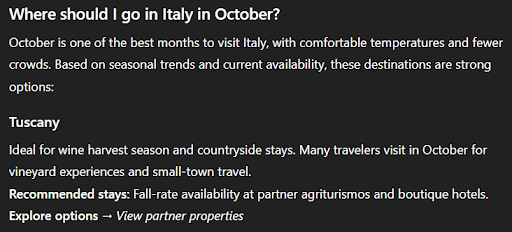
It’s great to have the ability to plan your entire trip through a single interface and have it feel like you’re just chatting about it to boot. Of course, such high engagement means high-cost ads, don’t expect to spend £5 a day, but it could be worth it to target these users.
Ads as part of the conversation
So what could these ads look like beyond just “Click here to see more”?
From pop-ups to banners, advertising online can be obnoxious, to say the least. Opening up chatbots as a potential avenue for advertising, because they can take many forms:
- contextual recommendations
- personalised offers woven into responses
- call-to-action buttons (“Explore tour dates” / “Get a quote”)
- comparison blocks with branded options
It feels more natural in the conversation, and lets tour operators offer deals without seeming pushy, highlighting the value of your brand.
Because people seem to trust chatbots more than you would imagine. While this trust can be leveraged to enhance the persuasiveness of your messaging, it can also introduce challenges to watch out for.
How your brand is represented through AI software that can be unpredictable is always a risk.
What to watch out for with AI advertising
In the fast-moving arena of Artificial Intelligence, it can be unpredictable to rely on, especially if it is a potential revenue stream.
1. Commoditisation
If AI starts serving generic tour ads based on price alone, operators who sell experience and expertise might struggle to stand out.
Solution: Focus your ad messaging on differentiation: storytelling, unique selling points (USPs), and human experiences.
2. Dependence on platform algorithms
Ad visibility could depend on ChatGPT’s internal scoring, not your own targeting. Being at the whim of an algorithm can severely cut your success when there is an update or change to the way that the algorithm works.
Solution: Diversify your presence across other channels while experimenting here, and when in doubt, always remember to “never keep all your eggs in one basket”.
3. Cost uncertainty
CPMs, CPCs, and placement types all may evolve rapidly. Without transparency, smaller operators could be priced out, especially if ChatGPT advertising follows the common trend as other platforms, where Cost-per-Click (CPC) has been increasing year-over-year.
Solution: Start small, track ROI closely, and plan bids strategically.
Diversify your visibility
Advertising has always been a big part of the puzzle for any tour operator, but it’s expensive and tricky to get right without constant attention.
Dedicated platforms and distribution partners are a surefire, proven way to boost your visibility and reach customers who are already looking for your services.
Listing your products on as many high-quality OTAs as possible is the best way to get seen and boost bookings. With the best channel manager at the heart of this, you can take away the hassle of manual updates and watch your bookings increase.
Contact Palisis to get in front of more customers and truly amplify your tours and activity products’ visibility online.