Bad PR is inevitable. In an era of social media, smartphones, and 24-hour news cycles, brands are no longer judged solely by their products but by how they respond to crises.
These moments may seem like a disaster, but inside this negative publicity lies opportunity. It can become a brand-defining moment to boost awareness, engagement, and potentially even revenue.
Handled poorly, it can permanently damage trust.
So how do you turn it around?
Five examples of PR nightmares
Most PR crises fall into one of four categories. Understanding which one you’re dealing with determines whether a turnaround is even possible. After all, not all public crises are created equally.
1. Conflict & ego-driven controversy
In 2026, everyone is a celebrity. It’s never been more important to think twice about how your behaviour can impact your professional life, including your company brand.
Public arguments, feuds, or provocative statements, often involving founders, CEOs, or public figures, are more common than ever, and very widely accessible.
Example: Michael O’Leary vs. Elon Musk
Recent controversy regarding Elon Musk of Twitter (Do we have to call it X?) and Michael O’Leary of Ryanair is one such example. A feud that started with Musk calling out O’Leary for refusing to install Starlink on his company’s planes devolved into Musk polling his followers about potentially buying Ryanair.
In response, Ryanair not only declined such an offer but also ran a very provocative tongue-in-cheek campaign across its airline.
Offering drastically reduced tickets for the “Big Idiot Seat Sale” featuring a small figure of O’Leary playfully bashing Musk over the head with an “I <3 Ryanair” sign”.

Why it worked
- The customer benefitted with ticket reductions
- No customers were harmed
- The response was fast, funny, and controlled
Overall, O’Leary and Ryanair came out looking pretty good with heightened engagement, brand publicity, and a boost to bookings. With Musk’s outbursts becoming infamous on X (there I said it), it was easy for O’Leary to come out looking pretty mature by publicly dismissing the entire affair.
Lesson:
No publicity is bad publicity… Provided you keep the customer in mind at all times. Feuding for ego looks bad, but fighting and sharing the spoils with your customers is worth it.
2. Viral moments & accidental exposure
Unplanned incidents that explode online, often involving individuals rather than the brand itself. People getting caught doing something they shouldn’t is as old as the internet itself, though nowadays it’s easy to find out who people are.
And getting caught doing something wrong with a work colleague is even worse…
Example: The Coldplay kiss-cam incident
A brief kiss-cam moment at a Coldplay concert unexpectedly thrust a previously low-profile tech company into the spotlight after two executives were identified in the clip. The story quickly spiralled beyond entertainment into questions of workplace conduct.
They were immediately under scrutiny, but what’s more is that this turned into a huge internet sensation. A meme that would be recreated countless times.
What went wrong
Beyond the discussion of what constitutes a breach of professionalism, both of the two people in question are- well, were married at the time. Which suddenly turns this from a funny workplace romance into an act of infidelity.
The CEO’s resignation, the lack of control of the narrative, the severity of the act, and the memes that followed all added up to a perfect storm for a PR nightmare.
The threat of trying to sue Coldplay was floating around the rumour mill for a while.
Why it worked
Soon after the event, Astronomer released a short video featuring A-list celebrity Gwyneth Paltrow to humorously refocus on the debacle, whilst also injecting some marketing.
Set up as a Q&A, they swiftly ignore the actual question to promote their automated workflow capabilities and upcoming industry events.
Lesson:
Act quickly to resolve the crisis, but don’t try to run away. Embrace the situation and find a way to pivot to what makes your brand the best.
3. Product & service failures
The most common, and perhaps most boring, form of bad PR is simply when things don’t work. However, this is rarely a one-size-fits-all situation. Depending on the severity of the problem, you might be able to turn it around with humour or strictly business.
Low-stakes example: KFC’s UK chicken shortage
Fast-food restaurant chain KFC ran out of chicken – gasp! Horror! Say it ain’t so!
The company faced ridicule online and customer frustration. After all, when your bread and butter is chicken, you better hope you have chicken to sell.
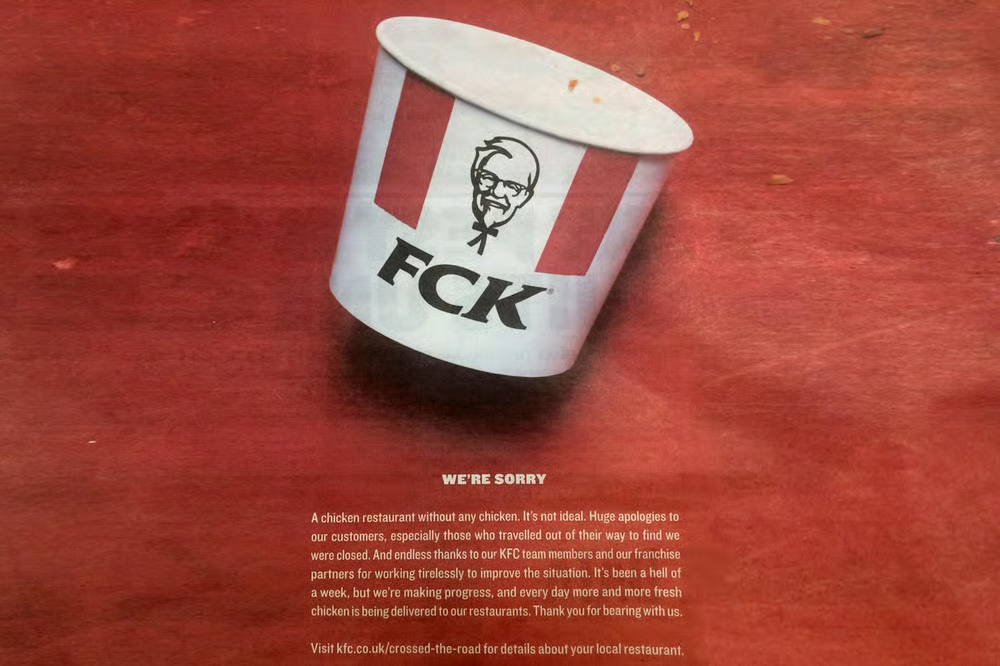
However, KFC is known for its irreverent marketing, and so in response to this, they forwent the corporate apology and instead opted for a full-page ad. One that rearranged their logo to read “FCK”.
Why it worked
They didn’t hide from the issue and took honest ownership of the problem. Using self-deprecating humour, they were able to show that they don’t take themselves too seriously, acknowledged their mistakes and gave a pretty unforgettable apology.
At the end of the day, it is just Kentucky Fried Chicken.
High stakes example: Exploding Samsung phone batteries
In 2016, world-renowned tech company Samsung released the Galaxy Note 7, which had a battery with a tendency to catch fire and blow up.
The company tried to repair the model and replace it with a new battery, which… Also exploded…
Ultimately, they were forced to recall all models of the phone, issue a stark, formal apology, and implement new procedures and safety standards to never let this issue happen again. All of which cost the company billions of dollars.
Why it kind of worked
This is a serious problem and requires a serious response. If they had taken the KFC approach, they would have faced immense backlash due to the cost of the item and the danger of the error.
Sometimes “boring” is the only way to go. Of course, that didn’t stop online content creators from panning the company.
4. Ethical, Cultural, or Values-Based Crises
Issues involving discrimination, data misuse, labour practices, or environmental claims. These are the hardest to recover from.
Messing up with personal data or abusing the trust of your customers is always going to be hard to navigate. Sometimes even impossible.
Failure Example: Fyre Festival
Initially framed as a luxury experience, the disastrous execution exposed deception, poor planning, and influencer manipulation.
In an attempt to kickstart an app to book celebrities for events, the Fyre Festival used a combination of celebrity endorsement, influencer marketing, and straight-out lies to sell tickets ranging from $500 to $12,000.

The result was a disaster. “Luxury experience” ended up amounting to a limited number of porta-potties and cheap food.
And one day later: CANCELLED.
Why it failed
Lies, bad faith, manipulation, and scamming customers are bad enough. But when these people are also affluent social media personalities, celebrities, and investors. That’s a recipe for disaster.
And 6 years in jail.
Lesson:
Some bad PR isn’t a marketing opportunity – it’s a reckoning. If the issue undermines your core integrity, there is no “spin” that will fix it.
But an even more crucial lesson here is that marketing and PR material need to deliver on the promised experience. Booking amazing tours and activities only works when the customer walks away happy.
Understanding the way that reputation feeds into credibility, and how your reputation governs your future success, is more important than clever ways of getting out of trouble.
The secret to turning bad PR into good marketing
At its heart, your company needs to have a heart. It sounds cheesy, but having a strong brand that is loved by customers for excellent service and amazing products is the key to overcoming and outflanking small controversies.
Your CEO might get caught on a kisscam, however if you have a wealth of talent in your organisation who were not caught at a Coldplay concert, you can turn it around. Especially with your customers, who know, respect, and love your services.

For a tour operator, this could be as simple as having a seamless ticketing technology, or a booking system that is simply too good to replace.
When Bad PR can’t be “Turned Around”
Bad PR cannot become good marketing when it’s not a joke. There is a difference between running out of fried chicken and breaking the law or hurting your customers.
While a genuine mistake or faulty product can be turned around if your leadership takes accountability, apologises, and takes all steps necessary to stop it from happening again. This gets harder, or even impossible, when you intentionally lie and mislead.
If you are guilty of that, then good luck because Hell hath no fury like a customer scorned.
Day-to-day PR
It might not be as exciting as Twitter arguments and massive sales, but every day you are juggling your reputation.
The quality of your service speaks volumes about your company and will be passed around by word of mouth, especially on social media and review sites.
Ensuring that your customers have a smooth experience with booking and ticketing is crucial, as is being able to reach them across countless OTAs, DMCs, and booking partners. All of this builds up your reputation, gets you trustworthy reviews, and helps you grow into an industry leader.
Contact us today to see how Palisis can boost your profile, and your bookings.