According to the headlines, Europe is in the grip of a tourism crisis. According to the tour operator in Vienna, it’s Tuesday and the 10.30 departure is fully booked.
Somewhere between the breaking news alerts, the dramatic airport footage and your actual booking numbers lies a rather important question: is any of this affecting your business?
Protests, political uncertainty, extreme weather and economic worries can make travellers nervous. Understandably so.
But before you start rewriting your forecasts, slashing prices or cancelling the staff Christmas party, it’s worth checking whether your customers are actually behaving differently.
Because a quiet Tuesday in November isn’t necessarily a tourism crisis. Sometimes it’s just November.
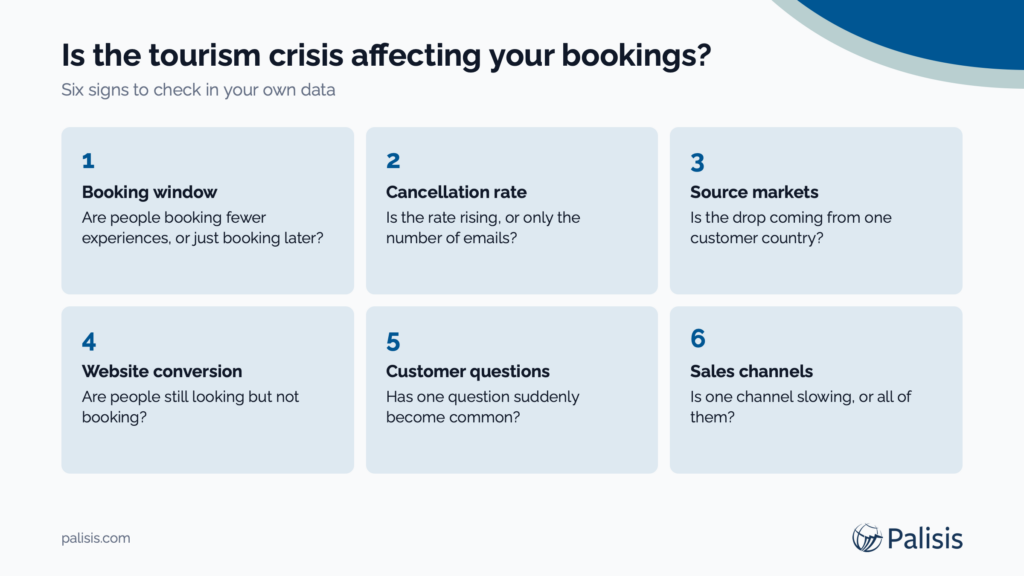
In short, to find out whether the tourism crisis is affecting your bookings, check six things in your own data: booking windows, cancellation rates, source markets, website conversion, customer questions and sales channels.
What does the data say about the tourism crisis in Europe?
European tourism is showing an interesting contradiction right now.
According to the European Travel Commission, 81% of Europeans planned to travel between June and November 2026, four percentage points more than in the same period of 2025.
Yet a June 2026 survey by ETOA, the European tourism association, found that 35% of the tour operators, wholesalers and destination management companies (DMCs) that responded reported a high impact from the Middle East crisis, while 21% reported little or no impact.
Same industry. Very different experiences.
Neither statistic tells you what’s happening to the sightseeing buses in Edinburgh or the boat tours in Barcelona.
For that, you’ll need your own numbers.
1. Are bookings falling, or are people just booking later?
Imagine it’s Monday morning. You open your booking report, compare it with last year and discover you’re 15% behind.
Not the ideal start to the week.
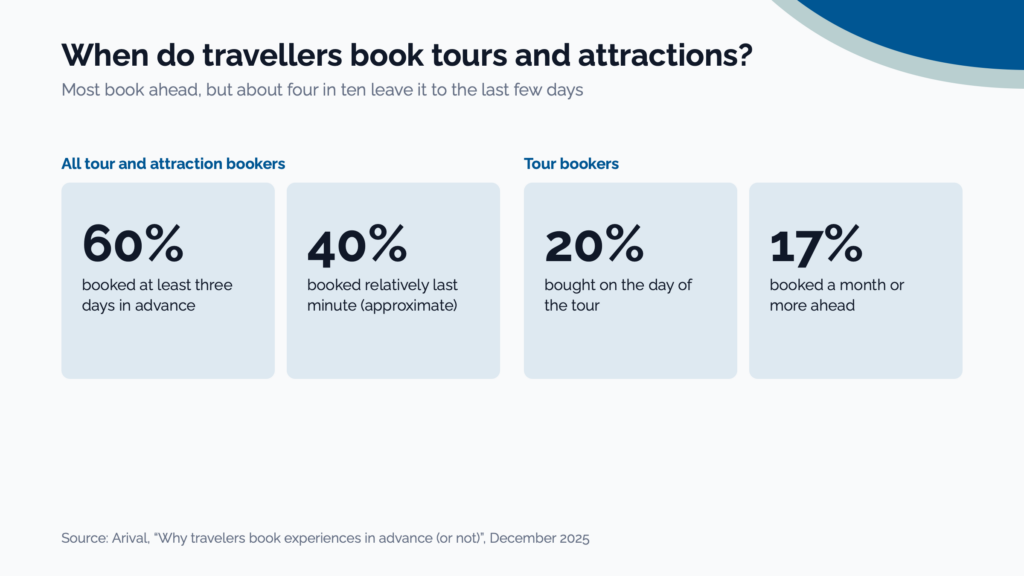
But before declaring an emergency, check your booking window: the time between the moment a customer books and the day they travel.
Are customers booking fewer experiences overall, or are they waiting until they’re actually at their destination?
What to check:
- Average number of days between booking and departure.
- Forward bookings compared with the same point last year.
- Final occupancy rates for completed departures.
If people are booking three days before departure instead of three weeks, your forward bookings can look frightening even when final demand remains healthy.
That’s a forecasting problem, not a demand problem.
2. Are cancellations actually increasing?
Three cancellation emails before your morning coffee can feel like the beginning of the end.
But three cancellations out of 500 bookings? That’s a different story.
Look at your cancellation rate (cancellations as a share of total bookings), not simply the number of cancellations you’ve received.
Compare equivalent periods and investigate whether particular products, dates or customer groups are affected.
And remember, a customer moving their booking to next Thursday isn’t necessarily lost business.
What to check:
- Cancellation rate compared with the same period last year.
- Refunds versus reschedules.
- Whether customers are giving similar reasons for cancelling.
3. Is the problem coming from one particular source market?
A tour operator in Paris might see American bookings decline while demand from France, Germany and Spain remains perfectly healthy.
Another operator, selling almost exclusively to American visitors, could feel that same change much more severely.
Both experiences are real. Neither tells the whole story about European tourism.
The European Travel Commission’s Long-Haul Travel Barometer, published in February 2026, found that travellers from overseas markets were becoming more cautious about long-haul trips, with affordability and limited holiday time shaping their plans.
So, where possible, compare your bookings by customer country, also known as source market.
If one market is struggling, you might need a more targeted marketing approach rather than a wholesale change to your business.
What to check:
- Bookings by customer country compared with the same period last year.
- How much of your total business each market represents.
4. Are people still looking but not booking?
Here’s an interesting one.
Your website traffic is normal. People are browsing your tours, checking availability and looking at prices.
But fewer are completing their bookings.
That could indicate hesitation. It could also mean your checkout has a new technical problem.
Before blaming the international political situation, check both.
What to check:
- Website visits.
- Booking conversion rate (the share of visitors who complete a booking).
- Abandoned checkouts.
- Whether particular products have become less popular.
If you’re seeing fewer visitors but your conversion rate is stable, the issue may be reduced interest or visibility.
If traffic remains steady but conversion drops, investigate the booking experience, prices and customer concerns.
The distinction matters.

5. Have customer questions suddenly changed?
Sometimes your customer service team knows something is happening before your reporting does.
Are travellers asking whether it’s safe to visit? Whether the tour is still operating? Whether they can get their money back if their flight is cancelled?
A few unusual questions might mean nothing. A sudden increase in the same question is worth investigating.
Speak to your ticket office, guides and customer service team.
They hear the concerns that don’t always make it into a booking report.
If the same question keeps coming up, answer it clearly on your website and in booking confirmation emails.
Just make sure you’re using current, official safety and travel information. Reassurance is useful, but it should never replace genuine safety advice.
What to check:
- The questions your front-line teams are hearing most often.
- Whether one question has suddenly become much more frequent.
6. Is the slowdown happening across every sales channel?
If your direct website sales are doing well but bookings through one online travel agency (OTA) have fallen, that’s useful information.
It could reflect changes in how that platform promotes your experiences, a shift in its customer base or a problem with your availability.
Compare performance across your sales channels before concluding that demand has disappeared.
What to check:
- Bookings by sales channel (website, ticket office, OTAs and resellers) compared with the same period last year.
- Whether your availability and prices are showing correctly on each channel.
This is where connected booking and distribution systems become particularly useful.
With solutions such as Palisis and TourCMS, operators can manage bookings and distribution across multiple channels, reducing the need to piece together information from separate platforms.
If you’re wondering how those systems differ, we’ve covered it in our guide to channel managers versus booking systems.
A bad week or a genuine tourism crisis? How to read your booking data
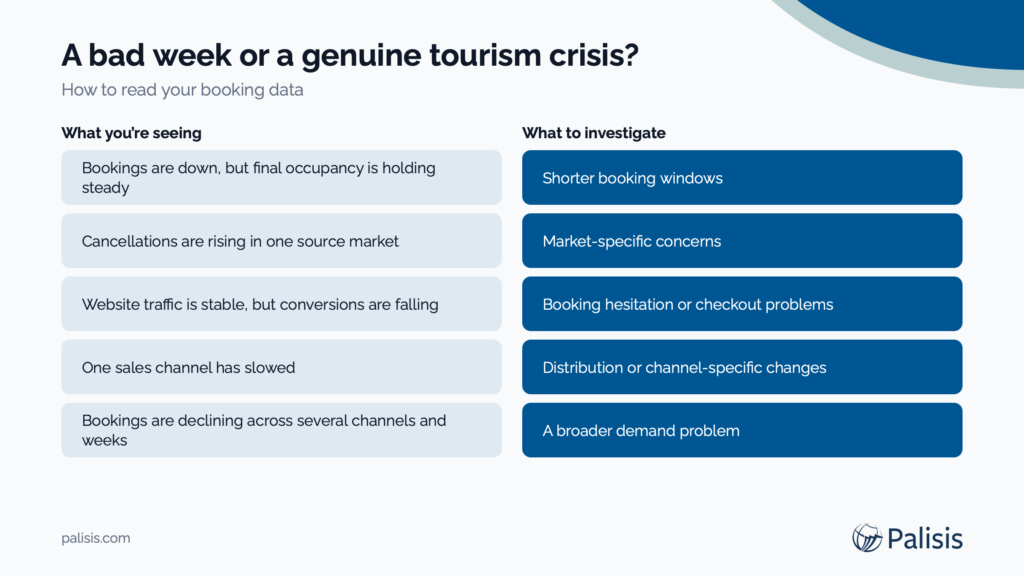
Here’s a quick way to interpret what you’re seeing.
- Bookings are down, but final occupancy is holding steady. Investigate shorter booking windows.
- Cancellations are rising in one source market. Investigate market-specific concerns.
- Website traffic is stable, but conversions are falling. Investigate booking hesitation or checkout problems.
- One sales channel has slowed. Investigate distribution or channel-specific changes.
- Bookings are declining across several channels and weeks. You may be looking at a broader demand problem.
The golden rule? Compare like with like.
Look at the same weekdays, school holiday periods, seasonal patterns and booking lead times. Where possible, use several weeks of data rather than one particularly disappointing afternoon.
A simple rule of thumb: one bad week is noise. Three or four weeks in a row, measured against the same weeks last year, is a pattern worth acting on.
The smaller your numbers, the more patient you need to be. If you take 40 bookings a week, five more or five fewer is normal variation, not a verdict on European tourism.
And look for agreement between the signs. One indicator moving on its own is a question. Two or three moving together is an answer.
And don’t forget to account for your own changes. If you’ve raised prices, reduced departures or paused your advertising, those things can affect bookings too.
What to do if the tourism crisis is affecting your bookings
Once you know which pattern you’re dealing with, the response becomes much more specific.
- Customers are booking later. Adjust your forecasts and staffing to the new booking window, and keep last-minute availability open on every channel. Resist early discounting, because the demand may simply be arriving later.
- Cancellations are rising. Find the common reason first. Where you can, offer a free date change before a refund, and make your cancellation terms easy to find.
- One source market is down. Move marketing budget towards the markets that are still booking, including domestic and nearby ones, rather than changing prices for everyone.
- Visitors are browsing but not booking. Test your checkout yourself, on a phone. Then answer the questions causing hesitation (safety, refunds, whether tours are running) on the product page, before customers have to ask.
- One sales channel has slowed. Check that your availability, prices and content are correct on that channel, then speak to your contact there before assuming demand has gone.
- Bookings are down everywhere, for weeks. This is the moment for bigger decisions: revising forecasts, reviewing departures and costs, planning promotions. Base them on your own numbers, not on the headlines.
So, is there actually a tourism crisis?
Maybe. For some operators, absolutely.
Political instability, transport disruption and changing traveller confidence can have serious consequences. The ETOA research makes that clear.
But the impact isn’t consistent across destinations, businesses or customer markets.
And that’s why your own booking data matters.
If you’re seeing genuine changes, investigate them early. If bookings are healthy, you probably don’t need to panic because someone on Facebook has announced the death of European tourism.
Sometimes the headlines are right. Sometimes they’re reporting a problem 800 miles away from your perfectly functioning tour.
Either way, your booking data is a better place to start than the comments section.
Although, admittedly, the comments section is usually more entertaining.
If you’d like to see how Palisis brings your bookings and distribution together in one place, take a product tour or get in touch with our team.